Mitral regurgitation (MR) means that the mitral valve does not close properly, so some blood leaks backward into the heart's upper chamber each time the heart pumps. Mitral regurgitation symptoms may be absent for years, and then appear as breathlessness, tiredness or palpitations when the leak becomes significant. This guide explains the causes, tests and treatment options, including repair by catheter, in simple language.
Key points at a glance
- A mild leak is common and often causes no symptoms.
- A severe leak can strain the heart and lead to heart failure and irregular heartbeat.
- An echocardiogram shows how severe the leak is.
- Moderate or severe leaks may need repair or replacement of the valve, and the timing matters.
What Is Mitral Regurgitation?
The mitral valve sits between the left atrium (upper chamber) and the left ventricle (lower chamber). It opens to let blood flow into the ventricle and closes when the ventricle squeezes blood out to the body. The MSD Manual defines mitral regurgitation as leakage of blood backward through the mitral valve each time the left ventricle contracts. To make up for the leak, the heart has to handle extra blood, and over time the left atrium and ventricle can stretch and weaken.
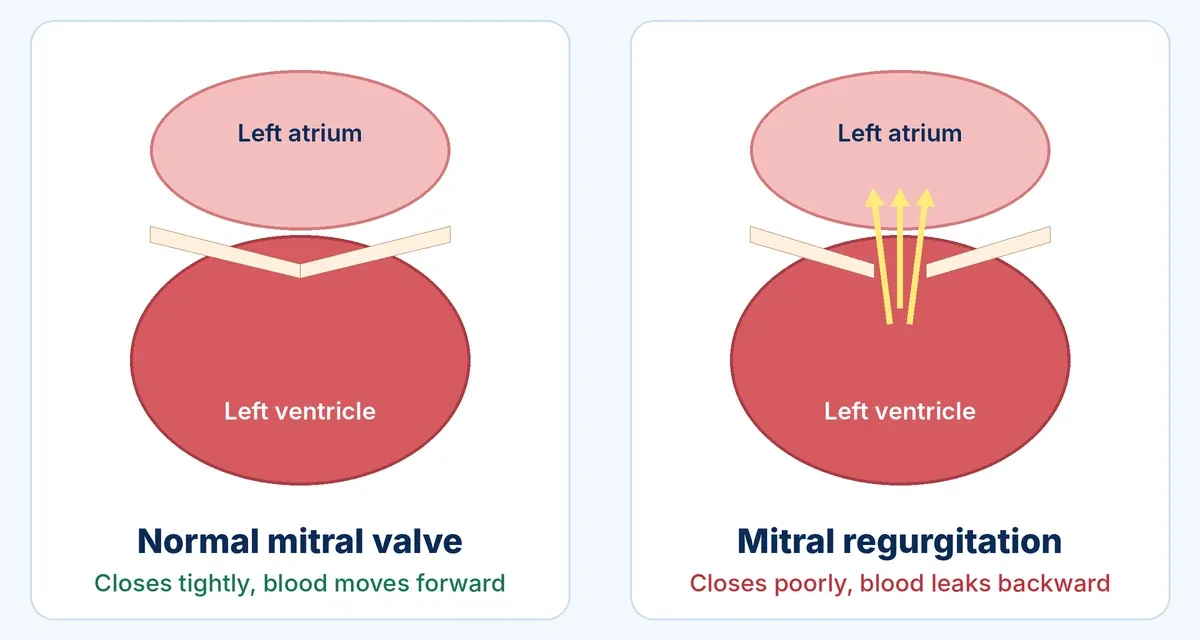
In mitral regurgitation the valve does not close fully, so some blood flows backward into the left atrium.
Acute and chronic mitral regurgitation
Chronic MR develops slowly over months or years and is the more common form. The heart adapts for a long time, so symptoms appear late. Acute MR starts suddenly, for example after a heart attack, an infection of the valve or an injury, and it can cause severe breathlessness. It is a medical emergency.
Mitral Regurgitation Symptoms: What You May Notice
Mild mitral regurgitation may not cause any symptoms. When the leak is larger, you may notice:
- Breathlessness, first on effort and later even at rest or when lying flat
- Unusual tiredness and reduced stamina
- Palpitations, often due to atrial fibrillation (see our guide on atrial fibrillation)
- Cough, especially at night, from fluid in the lungs
- Swelling of the feet and ankles in later stages
Warning signs that need urgent care
Seek emergency help at once for sudden severe breathlessness, chest pain, fainting or frothy cough. These symptoms overlap with a heart attack, so do not try to diagnose yourself. Read more on the signs of an unhealthy heart and on a cardiac emergency.
What Causes Mitral Regurgitation?
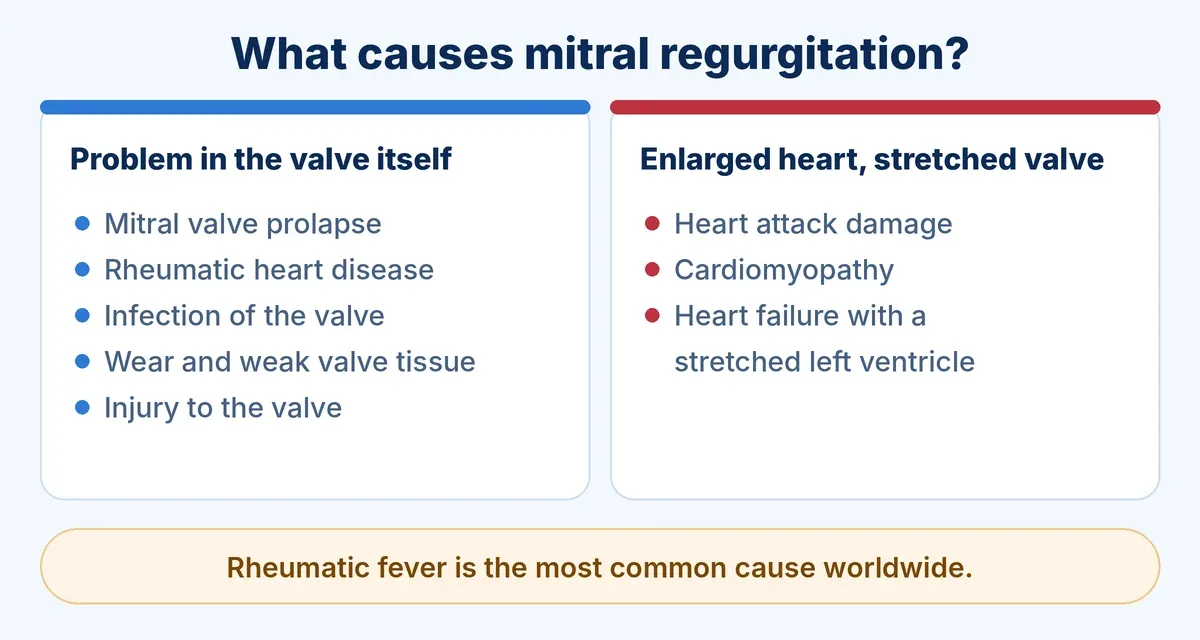
Mitral regurgitation can start in the valve itself or from an enlarged heart.
- Mitral valve prolapse and weak valve tissue: the leaflets are floppy and do not meet properly.
- Rheumatic heart disease: valve damage after rheumatic fever, which can follow an untreated strep throat, sometimes many years later. It is the most common cause worldwide and still important in India.
- Infective endocarditis: an infection that damages the valve.
- Heart attack and coronary artery disease: damage to the muscle that supports the valve.
- Cardiomyopathy and heart failure: an enlarged left ventricle stretches the valve ring so the leaflets cannot close fully. See congestive heart failure.
- Injury to the valve or its supporting cords
How Is Mitral Regurgitation Diagnosed?
- Stethoscope examination: a doctor may hear a characteristic murmur.
- Echocardiography: the key test. This ultrasound shows the valve structure, the direction and severity of the leak, and the size and pumping strength of the heart. A transoesophageal echo (a probe passed through the food pipe under sedation) gives a closer view when needed.
- ECG and chest X-ray: can show an enlarged heart, irregular rhythm or fluid in the lungs.
- Cardiac catheterisation or CT: checks the heart arteries, often before surgery. See our guide to coronary angiography.
Mitral Regurgitation Treatment
The right treatment depends on how severe the leak is, its cause, your symptoms, the size and strength of your heart, your age and other illnesses.
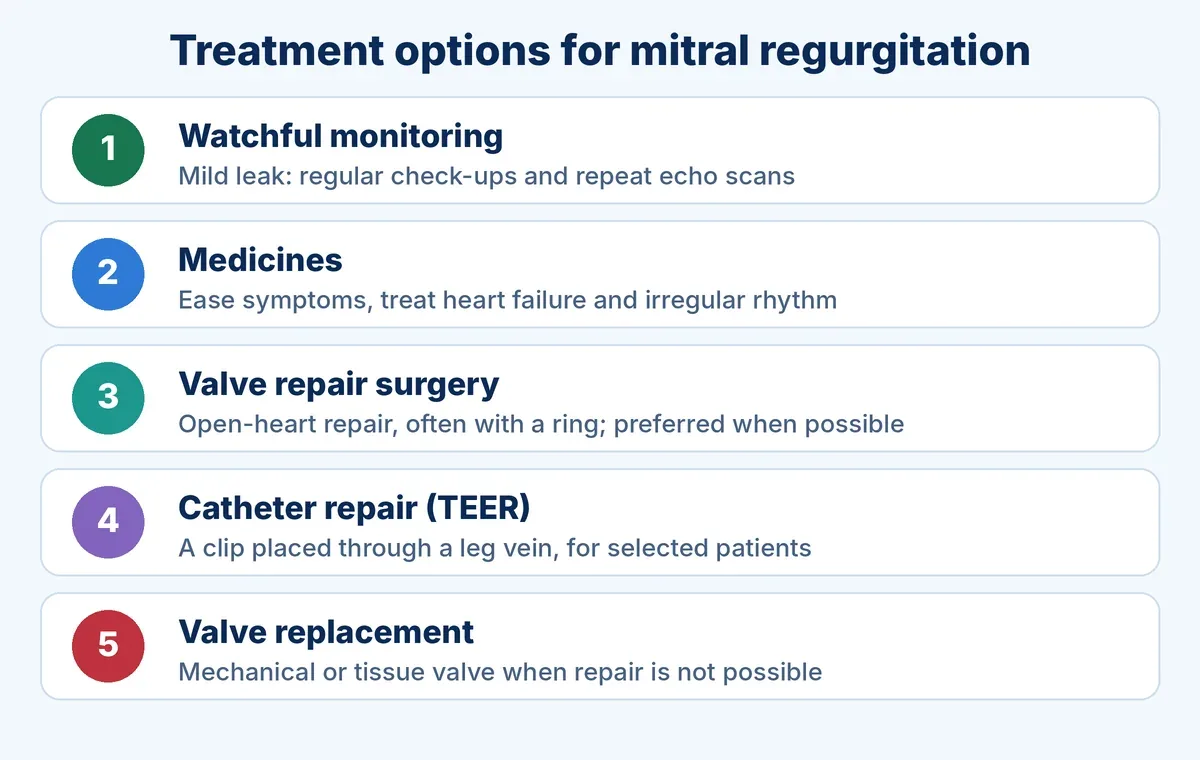
Treatment ranges from watchful monitoring to repair or replacement of the valve.
Monitoring for mild leaks
Mild mitral regurgitation often needs no specific treatment. You need regular check-ups and repeat echocardiograms to see whether the leak or the heart size is changing, and your cardiologist decides how often.
Medicines
Medicines cannot repair the valve, but they can ease symptoms and treat related problems. People with heart failure may be given medicines such as sacubitril-valsartan, spironolactone or carvedilol. Those with atrial fibrillation may need blood thinners. Do not stop or change any medicine on your own.
Mitral valve repair or replacement
When the leak is severe, or when it is causing symptoms or starting to weaken the heart, the valve needs to be fixed. Surgery should be done before the heart muscle becomes permanently weakened, so waiting too long is a risk.
- Surgical repair: the surgeon reshapes the valve and often adds a ring to narrow the opening. Repair is preferred when possible, because the patient's own valve is kept and lifelong blood thinners are usually not needed.
- Valve replacement: if repair is not possible, the valve is replaced with a mechanical or tissue valve. A mechanical valve needs lifelong blood thinners. Learn about the surgical approaches in minimally invasive vs open heart surgery.
- Transcatheter edge-to-edge repair (TEER, such as MitraClip): a clip is delivered through a vein in the leg and attached to the mitral valve to reduce the leak, without opening the chest. It is generally considered for selected patients with a severe leak who are not good candidates for open-heart surgery, and it usually means a shorter hospital stay.
- Catheter-based ring or valve procedures: newer options for selected patients. Read about mitral valve ring replacement without open-heart surgery.
Which option suits you depends on the valve anatomy seen on echo and CT scans, and on your overall health. Your heart team will explain the benefits and limits of each.
Living With Mitral Regurgitation: Everyday Tips
- Attend every follow-up visit and echocardiogram, even if you feel well.
- Keep blood pressure, sugar and cholesterol under control and avoid tobacco. See heart-healthy diet tips.
- Ask your cardiologist how much exercise is safe for you.
- Take care of your teeth and gums. If you have an artificial valve, you may need antibiotics before dental and some other procedures, so ask your doctor.
- Make sure children with a sore throat are treated properly, to help prevent rheumatic fever.
- Report new breathlessness, swelling or palpitations early, and do not wait for the next scheduled visit.
When Should You See a Cardiologist?
Book a consultation if a doctor has found a heart murmur, if you feel breathless or unusually tired on activity, if you have palpitations or leg swelling, or if you already know you have a leaky mitral valve and want to review the timing of treatment.
Mitral Valve Care in Jaipur
Dr. Prashant Dwivedi is an interventional and structural heart cardiologist practising at the Eternal Heart Care Centre and Research, Jaipur. Evaluation usually includes a detailed echocardiogram and, where needed, a CT scan, and the treatment plan is discussed with you and the heart team. To know what to look for in a valve specialist, read how to choose a heart valve replacement expert in Jaipur, or book an appointment for a personal assessment.
Frequently Asked Questions
Is mild mitral regurgitation serious?
Usually not. Many people have a mild leak that never causes problems. It still needs periodic echocardiograms, because the leak can increase over time.
What is the difference between mitral regurgitation and mitral stenosis?
In regurgitation the valve leaks because it does not close fully. In stenosis the valve is narrowed and does not open fully. Some people have both problems together.
Can mitral regurgitation be treated without open-heart surgery?
In selected patients, yes. A clip-based catheter procedure (TEER) can reduce a severe leak through a vein in the leg. It is generally used for people who are not good candidates for open-heart surgery, so your heart team will decide whether it suits you.
Can medicines cure mitral regurgitation?
No. Medicines can ease symptoms and treat heart failure or irregular rhythm, but they cannot repair a leaking valve. A severe leak needs repair or replacement of the valve.
When should surgery be done?
Doctors advise a procedure when the leak is severe and causes symptoms, or when tests show that the heart is starting to enlarge or weaken. Doing it before the heart muscle is permanently weakened gives better results, which is why regular follow-up matters.
This article is for general educational purposes only and does not replace personal medical advice, diagnosis or treatment. Please consult a qualified cardiologist about your own condition. In an emergency, go to the nearest hospital.

Dr. Prashant Dwivedi
Interventional and Structural Heart Cardiologist with expertise in TAVR, TMVR, MitraClip and advanced cardiac procedures.